In Q1 2026, new EU car registrations
In the first quarter of 2026, new EU car registrations rose by 4.2%. The market benefited from strong consumer activity, supported by updated and expanded tax incentives across major European countries. Hybrid‑electric vehicles remained the most popular powertrain choice, while the market share of battery‑electric cars increased to 19.7%. Plug‑in hybrids also continued to gain momentum, reinforcing the importance of a technology‑neutral approach to decarbonisation.
New EU car registrations by power source
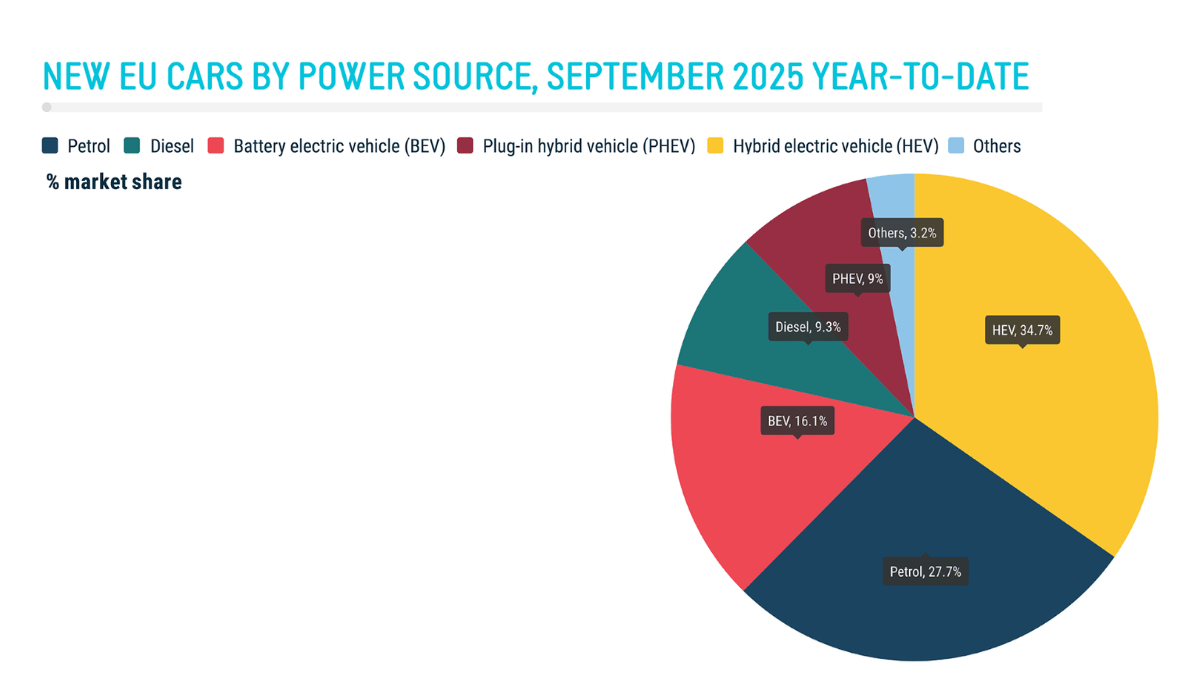
As stated in the document, “Battery electric cars accounted for 19.7% of the EU market share in Q1 2026”. This represents a clear increase from 15.2% a year earlier. Hybrid electric vehicles captured 38.6% of the market, maintaining their position as the preferred option among EU consumers. Meanwhile, the combined share of petrol and diesel vehicles declined to 30.3%, down from 38.2% in Q1 2025.
Electric cars
A total of 546,937 new battery electric cars were registered in Q1 2026, representing 19.4% of the EU market. The four largest markets — Italy, France, Germany, and Belgium — showed mixed results. Italy (+65.7%), France (+50.4%), and Germany (+41.3%) recorded strong growth, while Belgium experienced a slight decline of 2.3%.
Hybrid electric cars
Hybrid electric registrations increased to 1,089,421 units. Growth was driven by Italy (+25.8%) and Spain (+18.5%), with Germany (+7.4%) and France (+3.1%) also contributing positively. Hybrids accounted for 38.6% of the total EU market.
Plug in hybrid electric cars
PHEV registrations continued to rise, reaching 268,344 units in the first quarter. Italy (+110.1%), Spain (+74.2%), and Germany (+19.3%) were the main contributors to this growth. As a result, PHEVs now represent 9.5% of EU registrations, up from 7.6% in Q1 2025.
Petrol and diesel cars
Petrol registrations fell by 18.2%, with France showing the steepest decline at 40.3%. Italy (–18.6%), Spain (–18.1%), and Germany (–16.1%) also recorded significant drops. Petrol’s market share decreased to 22.6%, while diesel declined by 15.7% and accounted for 7.7% of new registrations.
Country level developments
Italy and Spain: strong Mediterranean momentum
Italy became a major driver of electrified mobility in early 2026. As the document notes, “Italian BEV registrations skyrocketed by an astonishing 65.7%”, supported by new government incentives. PHEVs surged by 110.1%, and hybrids increased by 25.8%.
Spain showed similar strength, with PHEV registrations rising by 74.2% and hybrid electric vehicles by 18.5%.
Germany and France: Europe’s core markets
France recorded a 50.4% increase in BEV registrations, accompanied by a dramatic 40.3% drop in petrol cars — the sharpest decline in the EU. Germany posted balanced growth across BEVs (+41.3%), PHEVs (+19.3%), and hybrids (+7.4%), despite a 16.1% fall in petrol sales.
UK and Northern Europe: diverging paths
The United Kingdom continued its steady shift toward electrification, supported by fleet mandates and tax incentives. Northern Europe — led by Norway, Sweden, and Denmark — maintained its position as the global frontrunner, with BEV shares consistently above 80%. Belgium, however, saw a slight BEV decline of 2.3% due to subsidy adjustments.
The Netherlands: a separate case
Market contraction due to fiscal changes
The Dutch market diverged sharply from the EU trend. As the document states, “The overall Dutch new car market contracted by 10.8% year on year”, ending the quarter with 81,480 registrations. This decline was caused by higher additional tax liability for new EVs (18%) and reduced road tax subsidies, which triggered a pull forward effect in late 2025.
The EV market share paradox
BEV registrations fell by 23.3% to 24,869 units. Yet BEVs still achieved a 30.5% market share — the third highest in Europe. Higher taxes pushed consumers toward alternatives: PHEVs captured 26% of the market, while hybrids dominated with 58.4% of all Q1 sales.
Conclusion
Q1 2026 illustrates a fragmented but undeniable shift toward electrification. Northern Europe continues to set the benchmark, while rapid growth in Italy, France, and Germany shows that targeted incentives and a diverse mix of hybrid technologies are effectively accelerating the transition away from fossil fuels.