Honda’s wireless EV charging: new opportunities for remanufacturing
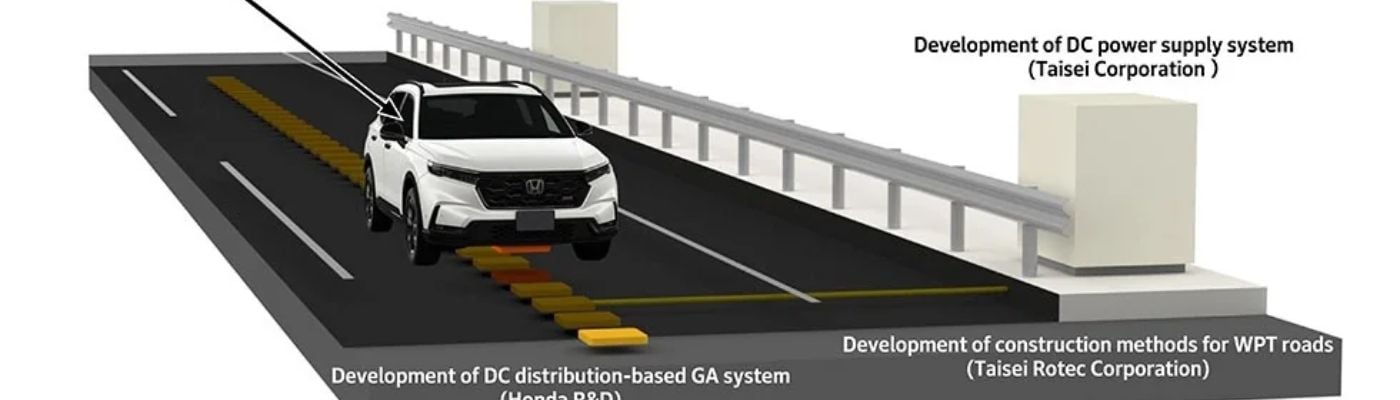
Honda R&D, working with Taisei Corporation and Taisei Rotec Corporation, has developed underlying technology for a road system capable of transferring electricity wirelessly to electric vehicles while they are moving. The companies plan to begin public-road demonstration testing in Japan from fiscal year 2027. Although the technology is still at the development stage, its potential applications to passenger cars and large commercial electric vehicles make it relevant to the future of the automotive remanufacturing industry.
From a remanufacturing perspective, Honda’s development of dynamic wireless power transfer (DWPT) technology represents more than an innovation in electric vehicle charging. It highlights the emergence of new components, electronic systems and infrastructure that could create future opportunities for the automotive aftermarket, component recovery and circular manufacturing.
A new generation of components to maintain and remanufacture
The Honda project relies on several interconnected technologies: power supply equipment, transmitter units embedded in the road, and a vehicle-mounted receiver that captures energy through magnetic coupling. The road assembly integrates an inverter and a coil into a single unit, while the infrastructure uses DC power distribution to support high-power transfer. For remanufacturers, these components could eventually represent a new category of products requiring specialist knowledge, diagnostic equipment and repair procedures. Power electronics, electrical connections, coils, control units and thermal management systems are all potential areas of maintenance and component recovery.
However, the actual remanufacturing opportunities will depend on the final production design, component accessibility, failure modes and availability of technical documentation. Unlike conventional internal combustion engine components, these systems combine electrical, electronic and electromagnetic functions. Their refurbishment would therefore require different processes from those used for turbochargers, alternators, starters, steering systems or braking components.
Expertise in electronic diagnostics, circuit testing, insulation assessment and functional validation could become increasingly important for businesses seeking to diversify into electric mobility. The distinction between repair, refurbishment and remanufacturing will also matter. Repairing a failed charging unit does not automatically qualify as remanufacturing. A genuine remanufacturing process would need to restore a used component to a specified performance standard through controlled industrial procedures, followed by appropriate testing and quality assurance.
Road infrastructure becomes part of the circular economy
One of the most interesting aspects of Honda's project is that the technology is not limited to the vehicle itself. The charging equipment is integrated into the pavement, requiring the coordination of automotive engineering, electrical infrastructure and road construction. This creates a potential circularity challenge beyond the traditional automotive supply chain. If wireless charging roads become commercially viable, their long-term sustainability will depend not only on energy efficiency but also on the durability, maintainability and end-of-life management of the equipment installed beneath the road surface.
Honda and its partners are developing road assemblies designed to withstand heavy commercial traffic, including vehicles with gross weights of approximately 20 tons. Their research also addresses installation in existing pavement and future upgrades to the infrastructure. Further testing is planned to evaluate durability, power-transfer performance and electromagnetic field leakage.
From a circular-economy perspective, the ability to replace individual modules rather than entire assemblies could become particularly valuable. If future designs allow defective coils, inverters or electronic modules to be removed independently, they could facilitate component-level repair and remanufacturing while reducing material consumption and waste. This is a potential design opportunity: infrastructure operators and remanufacturers would need to cooperate to establish practical disassembly methods, diagnostic procedures and recovery routes.
Heavy-duty electric vehicles could create new demand
Honda has identified logistics and transportation as priority applications for dynamic wireless charging. The technology is intended to serve passenger EVs as well as larger commercial vehicles, with future testing planned at power levels of up to 150 kW for potential heavy-duty applications. Commercial fleets could be particularly relevant to the remanufacturing sector because their vehicles often operate intensively and depend on predictable maintenance schedules. Reducing charging stops could improve operational flexibility, but it would not eliminate the need to monitor, service and eventually replace electrical and electronic components.
For remanufacturers already working with commercial vehicle systems, the transition could offer a pathway into adjacent product categories. Companies with experience in power electronics, electric motors, industrial electrical equipment and quality-controlled testing may be well positioned to investigate these emerging requirements. Nevertheless, it is too early to quantify the market opportunity. Public-road demonstrations must establish how the technology performs under real operating conditions before the industry can assess component failure rates, service intervals, repair costs or remanufacturing volumes.
Designing for repairability and remanufacturing
For the aftermarket, the long-term commercial value of wireless charging technology will depend partly on how manufacturers approach product design and serviceability. Components that can be disassembled without destructive procedures, diagnosed independently and replaced using standardized interfaces are generally easier to maintain and recover. Conversely, sealed assemblies, proprietary software, restricted diagnostic access or limited spare-parts availability could make independent remanufacturing more difficult.
Access to technical documentation, electronic fault codes, calibration procedures and reliable performance specifications will therefore be important. Safety requirements will be especially demanding because the equipment must transfer high electrical power while operating in a public environment and under repeated mechanical loads.
Any remanufactured unit intended for reuse would need to satisfy the relevant electrical safety, insulation, thermal performance and functional requirements. Where software or communication systems are involved, appropriate compatibility checks would also be necessary. OEMs, suppliers and independent aftermarket businesses should consider these requirements before the technology reaches large-scale deployment. Early cooperation could help establish viable recovery processes rather than leaving end-of-life treatment as an afterthought.
From electric vehicle components to infrastructure remanufacturing
Honda's initiative illustrates how automotive remanufacturing could gradually extend beyond the vehicle to include the infrastructure supporting electric mobility. As transport systems become more connected and electrified, the boundary between automotive components, energy equipment and road infrastructure will become less distinct. For remanufacturers, this evolution may create opportunities in electronic assemblies, power conversion equipment, electromagnetic components and specialized industrial modules. It could also encourage new partnerships between vehicle manufacturers, road operators, electrical engineering companies and aftermarket specialists.
The challenge will be to establish economically viable processes that maintain safety and performance while recovering the maximum possible value from used equipment. Reuse, repair, remanufacturing and recycling will have different roles depending on the condition of each component and the cost of restoring it.