Battery remanufacturing - part two
Efficient reverse logistics and end-of-life collection systems are indispensable to the remanufacturing ecosystem. As recycling and repurposing networks expand, the aggregation of used batteries from dealerships, repair centres, dismantlers, and OEM facilities has become more structured, though transport regulations for hazardous goods remain challenging.
 Gianluca Speziale
Logistics, business models, and economic value
Centralized remanufacturing hubs benefit from economies of scale, while decentralized processing closer to collection points can reduce transportation costs and emissions. Digital tracking platforms that monitor battery location, condition, and treatment history are increasingly vital for optimizing logistics and forecasting core availability. Business models are evolving alongside these operational changes. Some OEMs are pursuing vertically integrated remanufacturing to maintain control over quality and intellectual property, while third-party specialists’ partner under licensing agreements to access proprietary diagnostics and specifications. Battery leasing and battery-as-a-service models—where manufacturers retain ownership of the pack throughout the vehicle’s life—align incentives for durability, remanufacturing, and lifecycle optimization. These models are particularly effective in commercial fleets, where predictable usage patterns simplify return forecasting and support scalable programs. Economically, remanufacturing reduces total cost of ownership for EV users and mitigates exposure to volatile raw material prices by preserving functional components within a circular supply chain.
Environmental impact and future outlook
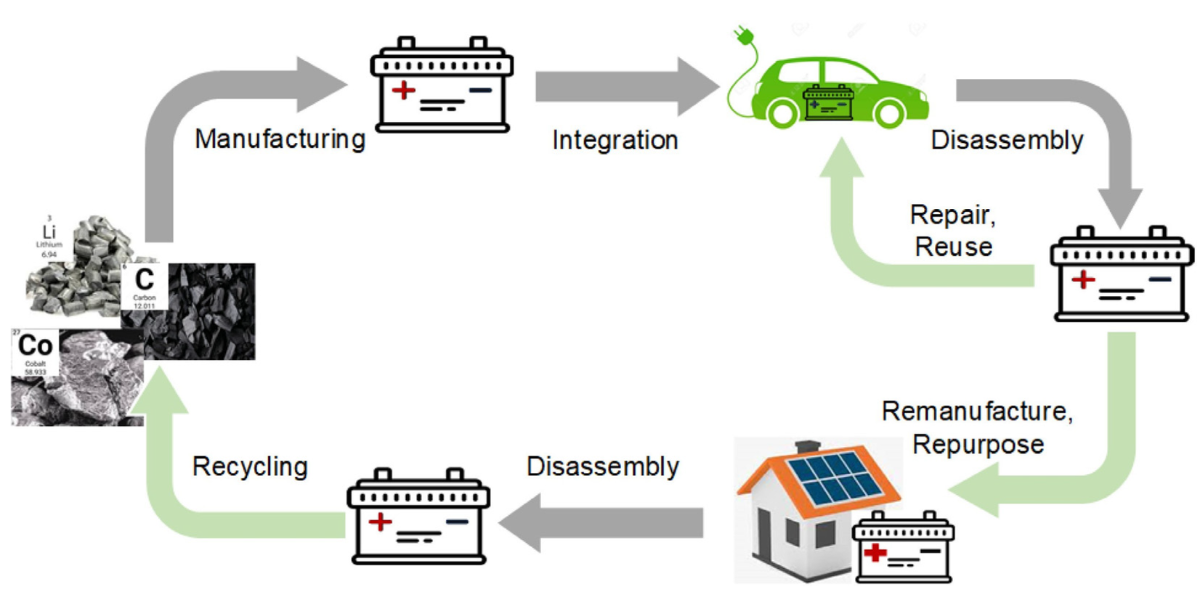
Lifecycle assessments consistently show that extending battery life through remanufacturing significantly reduces energy consumption, carbon emissions, and material extraction compared with producing new systems. Environmental benefits depend on factors such as electricity mix, transport distances, and process efficiency, but studies confirm substantial CO₂ and energy savings per restored pack. Second-life applications offer an additional pathway for batteries that no longer meet vehicular performance requirements yet retain usable capacity, enabling deployment in stationary energy storage, renewable integration, grid balancing, and backup power systems. These uses defer recycling while maximizing value extraction. Despite progress, barriers remain. Consumer concerns about reliability and safety must be addressed through transparent warranties, certification standards, and proven performance records. Intellectual property restrictions—particularly around proprietary BMS software and diagnostic data—can limit third-party participation. Economic viability also depends on sufficient volumes of returned batteries, though this is expected to improve as EV adoption grows. Technological innovation is helping to overcome these challenges: robotics and artificial intelligence are improving disassembly and sorting precision, while digital twin technologies enable lifecycle modelling that optimizes processes and reduces environmental impact. Workforce training, safety culture, and cross-sector collaboration remain essential to scaling operations. Looking ahead, battery remanufacturing is poised to become a cornerstone of sustainable mobility value chains. As electrified transportation expands and battery return volumes increase throughout the 2020s, scalable remanufacturing infrastructures will deliver advantages in cost efficiency, supply chain resilience, and environmental stewardship—solidifying their role within a circular automotive economy.