Circular Economy in Automotive Remanufacturing – Part Two
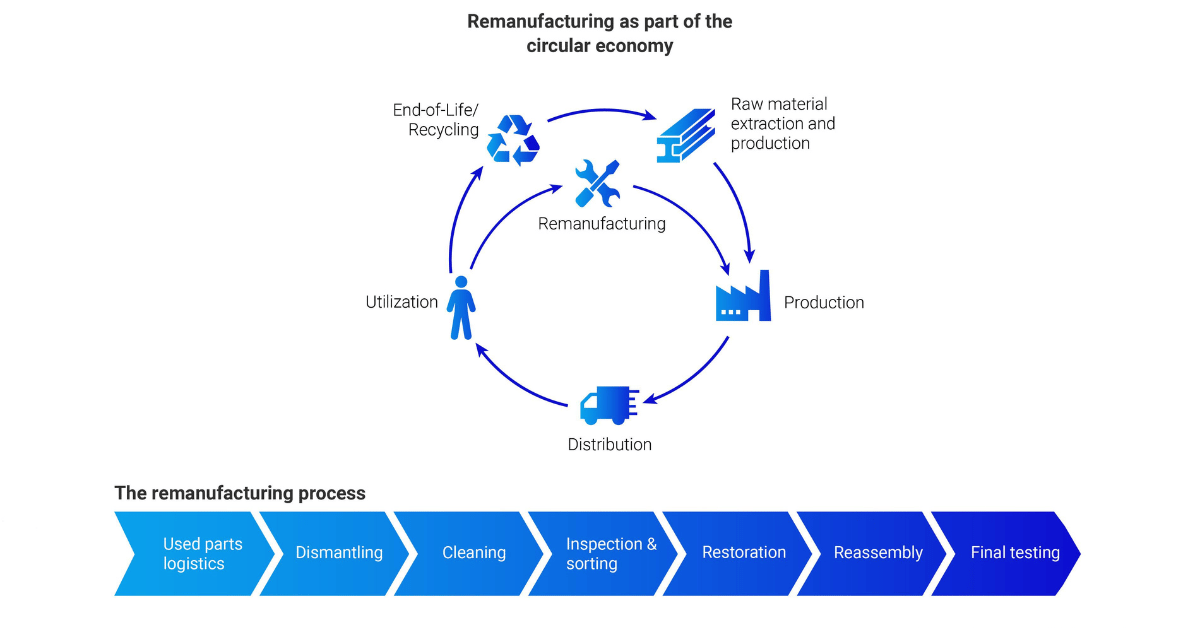
The automotive industry is currently undergoing one of the most profound structural transformations in its history, shifting toward a highly advanced circular economy centered on remanufacturing. Far from being a niche practice, remanufacturing is rapidly emerging as a cornerstone of sustainable industrial strategy across Europe.

AI in the remanufacturing process
Looking ahead, the integration of Artificial Intelligence into remanufacturing represents the next frontier. AI is already being used to predict when components are likely to fail, enabling more proactive maintenance strategies and improved lifecycle management.
In addition, AI-driven systems are increasingly automating the sorting, inspection, and cleaning of cores—tasks that have traditionally been labour-intensive, manual, and often considered “dirty work.”
This level of automation is significantly improving operational efficiency and strengthening the competitiveness of European remanufacturing industries against low-cost imports from outside the EU.
By 2026, the automotive remanufacturing sector is expected to be a fully digitally enabled, high-tech industry supported by some of the strongest consumer protection and environmental regulations globally. The combination of the Right to Repair framework and circular economy policies has created an ecosystem where product longevity is prioritized over planned obsolescence.
While challenges remain - particularly in scaling these systems for autonomous and software-defined vehicles - the EU’s regulatory and industrial foundations have firmly positioned remanufacturing as a key driver of a sustainable automotive future. The shift is no longer simply about extending the life of parts; it is about decoupling economic growth from raw material consumption.
A better scenario for independent repair shops
Recent European Union legislation, led by the Right to Repair Directive and the updated Vehicle Circularity Regulation, has fundamentally reshaped the operational landscape for independent repair shops by 2026.
For decades, small and medium-sized repair businesses operated under a “technical monopoly,” where original equipment manufacturers controlled access to the digital systems and physical components required for vehicle maintenance and repair.
Under the new framework, this imbalance has been significantly reduced in favour of a more open and competitive aftermarket. One of the most impactful changes is the restriction of “part pairing” and software-based locking mechanisms. Previously, manufacturers could ensure that vehicles only recognized components installed and coded within authorized dealer networks, often forcing customers into expensive repair channels.
The 2024 Right to Repair rules now require OEMs to provide independent workshops with equivalent access to software protocols, allowing them to install remanufactured or third-party components without triggering limp mode or persistent system errors. This regulatory shift unlocks a broad supply of affordable, high-quality refurbished parts, making repairs more accessible for price-sensitive consumers.
In addition, manufacturers are required to provide access to technical documentation, diagnostic tools, and spare parts for at least ten years after a vehicle model is withdrawn from the market. This “ten-year rule” provides independent repairers with long-term business stability, even as vehicles become increasingly complex and software-driven.
The SERMI certificate
To support secure access to vehicle systems, the EU has introduced the SERMI (Security-Related Repair and Maintenance Information) scheme, a unified certification framework for independent repairers across Europe.
Once certified, workshops gain legal and secure access to security-related vehicle data that was previously restricted to OEM-authorized networks. This includes high-value functions such as key programming and electronic immobilizer repairs. As a result, value is retained within local economies rather than being concentrated exclusively within manufacturer-controlled service networks.
Market transparency and consumer trust
Another important development is the introduction of the European Repair Information Platform, which increases transparency in the repair market. This platform enables consumers to compare repair options and identify workshops that actively participate in circular economy practices, such as using remanufactured engines, transmissions, and components. A standardized European Repair Information Form further enhances clarity and trust by ensuring consistent information across the sector. In addition, the legal requirement to extend warranty coverage by 12 months when consumers choose repair over replacement reduces perceived risk and strengthens confidence in independent repair shops.
Conclusion
Together, these developments are transforming independent repair shops from traditional mechanical workshops into advanced circular economy hubs. They now play a critical role in extending the lifecycle of modern vehicles while remaining competitive through legally supported access to data, components, and repair infrastructure. Ultimately, remanufacturing is no longer just a technical process, it is becoming a strategic pillar of Europe’s sustainable industrial future.